

Why Is My Profit So Slow?” I Asked Myself This After a Month of Trading…
I had just wrapped up four decent weeks in the forex market. Nothing crazy—just a little 1% win here, 1.5% there. But when I looked at my final balance? Underwhelming.
It felt like my trades weren’t actually working for me.
So I did what any overthinker would do—I opened a spreadsheet. And then I found it: the forex monthly compound interest calculator. That moment changed my trading mindset forever.
This blog walks you through everything I learned:
What compounding actually means in forex
A real breakdown: monthly vs weekly forex compounding
Exactly how much more you could earn with each method
Real-life examples using the forex monthly compound interest calculator
Clear verdict + graph comparisons
What is Compounding in Forex?
Okay, real talk: compounding is just profit earning more profit.
You’re not only making money on your trades—you’re letting those gains boost your trading power. And in forex, that can snowball fast.
Here’s the deal:
You start with $1,000
Make 5% in a week → now you have $1,050
Next week, you make 5% again → now it’s $1,102.50
That extra $2.50? It came from your previous gain
Repeat that enough times, and the results can be wild. That’s why traders love using tools like the forex monthly compound interest calculator to visualize how fast money can grow when you stop withdrawing and start compounding.
Compounding turns effort into momentum. And the more frequently you do it, the faster it adds up.
Monthly vs Weekly Forex Compounding: Numbers Don’t Lie
Let’s compare them side-by-side using actual numbers.
Assumptions:
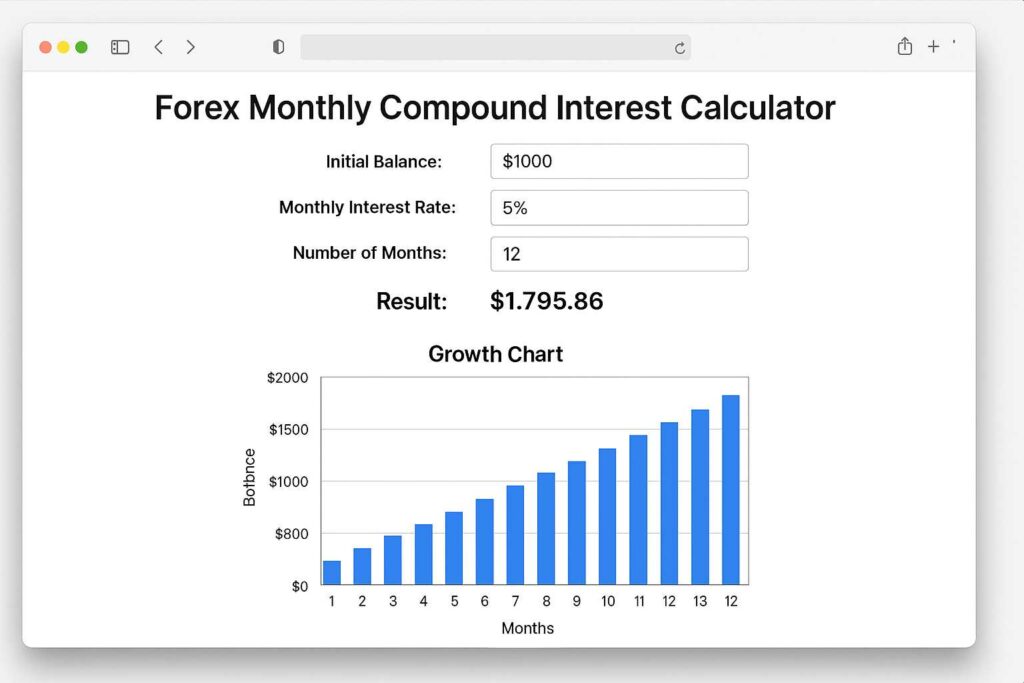
Initial Capital: $1,000
Growth per period: 5%
Timeframe: 12 months
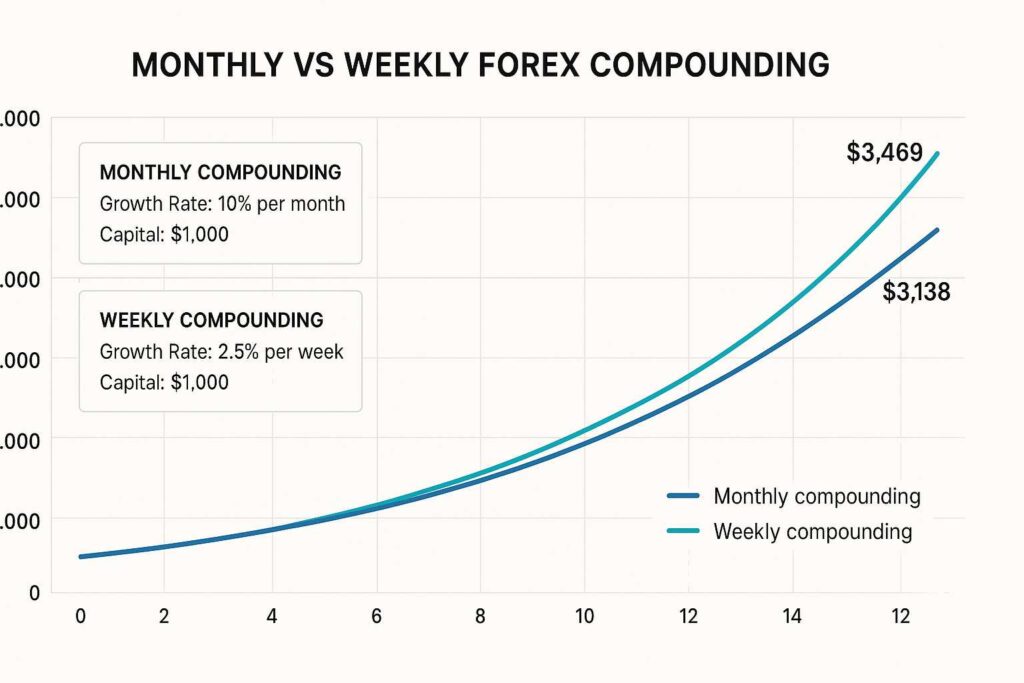
🔵 Monthly Compounding (Using Forex Monthly Compound Interest Calculator):
Total Periods: 12
Final Balance: $1,795.86
🔷 Weekly Compounding (Using Forex Weekly Compounding Calculator):
Total Periods: 52
Final Balance: $1,729.72
Now hold on. At first glance, monthly compounding looks better. But that’s only if the rate per period is higher than in weekly.
If you break 5% monthly into weekly (~1.15%), weekly will always win mathematically because of more frequent compounding.
That’s the power of the forex weekly compounding calculator. More frequency, even with smaller gains, can outperform less frequent compounding.
But how you use it really depends on your trading style.
Case Study: What I Did With $2,500 and a Plan
Earlier this year, I wanted to test it myself. So I used both calculators for a personal experiment.
Scenario:
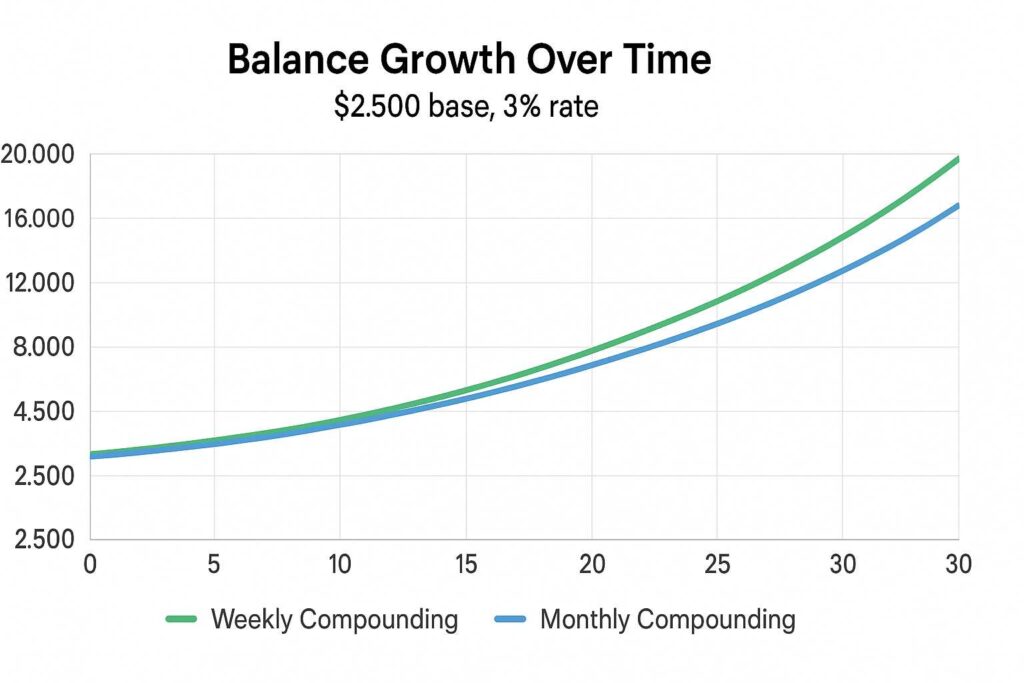
Capital: $2,500
Rate: 3% per period
Monthly vs Weekly Compounding
Results via Forex Monthly Compound Interest Calculator:
Monthly Compounding = $3,593.44
Results via Forex Weekly Compounding Calculator:
Weekly Compounding = $4,647.89
The difference? $1,054.45 in one year.
That blew my mind.
That’s when I realized: even small rate differences or extra cycles make a massive difference.
Why I Use the Forex Monthly Compound Interest Calculator
When I started out, I didn’t need full-on trading apps. I just needed a way to ask: “If I earn X%, how far can I go in a year?”
The forex monthly compound interest calculator did that perfectly.
No popups
No logins
No settings
Just clean input > clean result.
“As a freelancer, I already juggle deadlines. This tool quietly sits in my browser and shows how far I can go with 1% daily growth—no pop-ups, no stress.”
My 19-year-old cousin uses it too. He checks it every night to stay motivated. Watching that curve grow? Addictively satisfying.
But What About the Weekly Calculator?
Great question.
The forex weekly compounding calculator is perfect for:
Shorter-term strategies
Swing or day traders
Goal-based forecasting
Weekly growth feels more real-time. You see changes faster. And it’s easier to adjust goals if something throws you off course.
But for me, the forex monthly compound interest calculator is the long game tool. It gives me big picture clarity.
When I want to breathe and plan for the next six months? That’s the tool I use.
Conclusion: Which One Wins?
There’s no universal winner—but here’s a simple table:
| Feature | Monthly Compounding | Weekly Compounding |
|---|---|---|
| Easy Planning | ✅ Yes | ❌ Can be complex |
| Faster Growth | ❌ Fewer cycles | ✅ More frequent compounding |
| Simplicity | ✅ Clean layout | ❌ More data to enter |
| Visualization | ✅ Better for long-term | ✅ Better for short-term |
| Best Tool | Forex Monthly Compound Interest Calculator | Forex Weekly Compounding Calculator |
If you’re planning for quarterly or yearly goals—stick with monthly.
If you’re tracking short-term sprints—go weekly.
Or better yet, do what I do. Use both.
Related Blogs You Shouldn’t Miss
While testing, I relied heavily on these two:
Both are packed with simple visuals, examples, and usable inputs.
FAQs
1. What is the best compounding frequency for forex trading?
If you’re consistent, weekly wins. But if you’re in it for the long haul with limited time, monthly is cleaner. You can easily model either with the forex monthly compound interest calculator.
2. Can I use the forex monthly compound interest calculator on mobile?
Yup! It works beautifully on mobile browsers. No app needed.
3. Is monthly compounding better for low-risk strategies?
Yes. Longer gaps mean fewer adjustments. If you’re trading only 1-2 times a month, the forex monthly compound interest calculator shows you exactly where you’ll land.
4. How do I calculate compound interest in forex?
Use this formula: A = P(1 + r)^n or just plug it into the tool. It’s based on the standard compound interest formula.
5. Why does compounding matter in forex?
Because 1% every day or week might not look like much—but it can triple your money over time. The forex monthly compound interest calculator shows you that impact in seconds.
6. Can beginners use these calculators?
Absolutely. I recommend every new trader start with them. It builds habit, perspective, and patience.
Disclaimer: This blog is for educational purposes only and reflects personal experience. Forex trading involves risk, and past performance is not indicative of future results. Please do your own research before investing.


2 thoughts on “Monthly vs Weekly Forex Compounding – What Works?”
Hey there would you mind sharing which blog platform you’re using?
I’m looking to start my own blog in the near future but I’m having a tough time selecting between BlogEngine/Wordpress/B2evolution and
Drupal. The reason I ask is because your design and style seems
different then most blogs and I’m looking for something unique.
P.S My apologies for getting off-topic but I had to ask!
WordPress